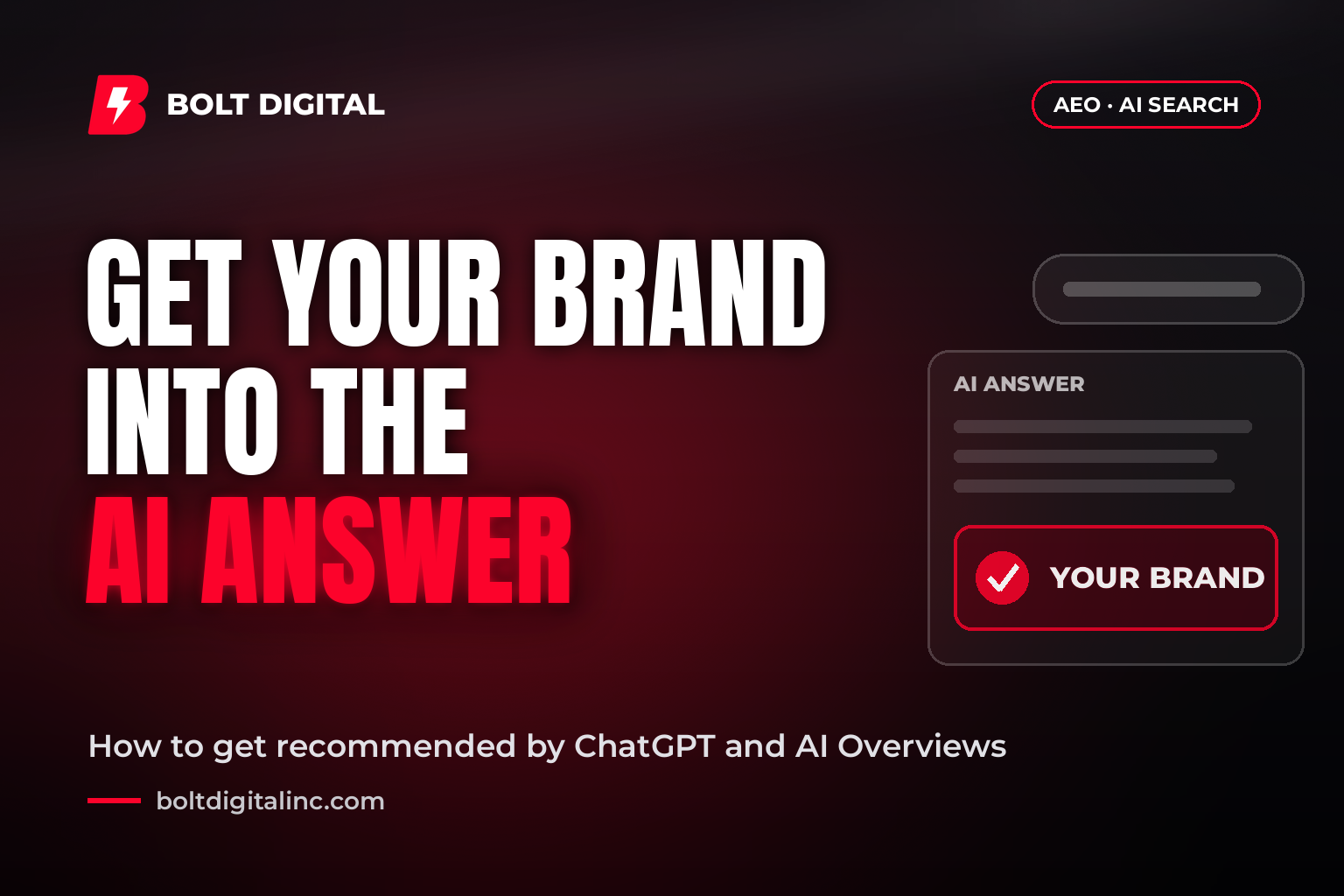
AI answers are the new first page. If ChatGPT and Google AI Overviews can’t understand your brand, they won’t recommend it.
More buyers now ask a question to an AI tool before they ever click a website. They type “best digital marketing agency for a clinic in Pune” or “how much should I spend on ads” and read the answer on the spot. If your brand is not in that answer, you are not in the race.
Here is the short answer: to get recommended by ChatGPT and Google AI Overviews, make your brand easy to find, easy to understand and easy to trust. Answer real buyer questions clearly on your own site, keep your business facts the same everywhere, earn mentions on other trusted sites and let AI crawlers read your pages. That work has a name: answer engine optimization (AEO), also called generative engine optimization (GEO).
What is AEO and how is it different from SEO?
SEO helps your page rank in a list of blue links. AEO helps your brand show up inside the answer itself.
- SEO: the goal is a click from a search results page.
- AEO / GEO: the goal is to be quoted, summarised or named in an AI answer, often with a link back to you.
The two are not rivals. AI tools still lean on pages that search engines can crawl and trust, so good SEO is the base. AEO adds a layer on top: clear answers, clear facts and clear proof that a machine can lift and reuse.
How do ChatGPT and Google AI Overviews choose which brands to mention?
Nobody outside these companies knows the full formula, and we won’t pretend to. But the pattern is clear from how they work:
- They pull from pages they can access. Google AI Overviews draw on Google’s own search index. ChatGPT search looks up live web pages when a question needs fresh information.
- They prefer direct answers. A page that answers the question in the first two lines is easier to quote than one that warms up for five paragraphs.
- They look for agreement. If many trusted sources describe your brand the same way, the AI is more confident naming you.
- They favour clear entities. A brand with a consistent name, location, services and contact details is easier to understand than one with mixed signals.
What is the simple AEO checklist for founders?
Work through these eight steps in order. Most brands can finish the first four in a week.
- List the questions your buyers ask. Pull them from sales calls, WhatsApp chats, emails and reviews. Write them in your buyer’s words, not your industry’s words.
- Answer each question on your site. Use the question as a heading, put a one or two line answer right below it, then add detail. This is exactly how this article is built.
- Add an FAQ section with FAQ schema. Structured data tells machines which text is the question and which is the answer.
- Make your business facts identical everywhere. Same brand name, address, phone, services and description on your website, Google Business Profile, LinkedIn page, Instagram bio and directories.
- Add Organization and LocalBusiness schema. This gives AI tools a clean, machine-readable card about who you are.
- Earn mentions on other sites. Guest articles, podcast appearances, industry lists, client case studies and honest reviews all count. Your own site says who you are; other sites confirm it.
- Let AI crawlers in. Check your robots.txt. Googlebot must be allowed for Google AI Overviews, and OAI-SearchBot must be allowed for your pages to appear in ChatGPT search.
- Keep content fresh. Update key pages when prices, services or facts change. Out-of-date pages lose trust with people and machines alike.
What kind of content gets quoted in AI answers?
Content that a machine can lift in one piece and still make sense.
- Clear definitions: “Cost per qualified lead is ad spend divided by qualified leads.”
- Comparisons: X vs Y pages that give a straight verdict, like our guide on Meta lead form vs landing page.
- Step-by-step lists: numbered steps with a short label in bold.
- Honest ranges and conditions: “It depends on your offer, and here is how to decide” beats vague advice.
- First-hand experience: what you have seen working with real clients, written plainly.
Avoid walls of text, hidden answers behind tabs or sliders, and pages that only make sense if you read them top to bottom.
How do you check if AI tools already mention your brand?
Run a simple test once a month:
- Write ten questions a buyer would ask before choosing a business like yours.
- Ask each one in ChatGPT and in Google search, and note whether an AI Overview appears.
- Record who gets named, which pages get linked and how your brand is described.
- Fix what is missing: a page that does not exist yet, a fact that is wrong or a competitor who is quoted instead of you.
Keep the results in one sheet so you can see progress over time. Treat it like any other metric and focus on what moves real enquiries, not vanity metrics.
What mistakes stop AI from recommending your brand?
- Blocking crawlers by accident through a security plugin, firewall rule or old robots.txt line.
- Different names and details across your website, maps listing and social profiles.
- Vague service pages that say “we deliver results” but never say what you do, for whom and where.
- No proof anywhere else. If only your own site talks about you, AI has little reason to trust you.
- Chasing tricks. Stuffing pages with prompts or keywords does not work. Clear, useful answers do.
How long does AEO take to work?
Technical fixes like allowing crawlers and adding schema can take effect as soon as your pages are crawled again. Earning trust through content and outside mentions takes longer, usually months, not days. The brands that win treat AEO as a habit: answer one more buyer question every week and keep facts consistent.
The bottom line
AI tools recommend brands they can find, understand and trust. Answer your buyers’ questions clearly, keep your facts consistent, earn mentions beyond your own site and let the crawlers in. Do that steadily and your brand becomes the easy answer.
Frequently asked questions
How do I get my brand recommended by ChatGPT?
Answer real buyer questions clearly on your website, keep your business details consistent across the web, earn mentions on trusted sites and make sure OAI-SearchBot is allowed in your robots.txt so ChatGPT search can read your pages.
How do I show up in Google AI Overviews?
Google AI Overviews draw on Google’s search index, so start with solid SEO: crawlable pages, direct answers under question headings, FAQ and Organization schema, and helpful content that earns trust.
What is the difference between AEO, GEO and SEO?
SEO aims to rank pages in search results. AEO (answer engine optimization) and GEO (generative engine optimization) aim to get your brand quoted or named inside AI-generated answers. Good SEO is the base for both.
Does schema markup help with AI answers?
Schema does not guarantee a mention, but FAQ, Organization and LocalBusiness schema make your facts and answers easier for machines to read and reuse, which helps.
Can I pay to be recommended by ChatGPT?
No. Organic ChatGPT answers cannot be bought. Brands earn mentions through clear content, consistent facts and trusted third-party coverage.
How long does AEO take to show results?
Technical fixes can show up after the next crawl, but building enough trust to be recommended usually takes months of steady content and outside mentions.
Want your brand to be the answer?
We audit how AI tools see your brand today, find the questions your buyers are asking and build the pages, schema and mentions that help you show up. If you want a clear plan, talk to our team.